
Industrial 3D Printing in Manufacturing: Where do Engineering Teams Use Additive Manufacturing Today
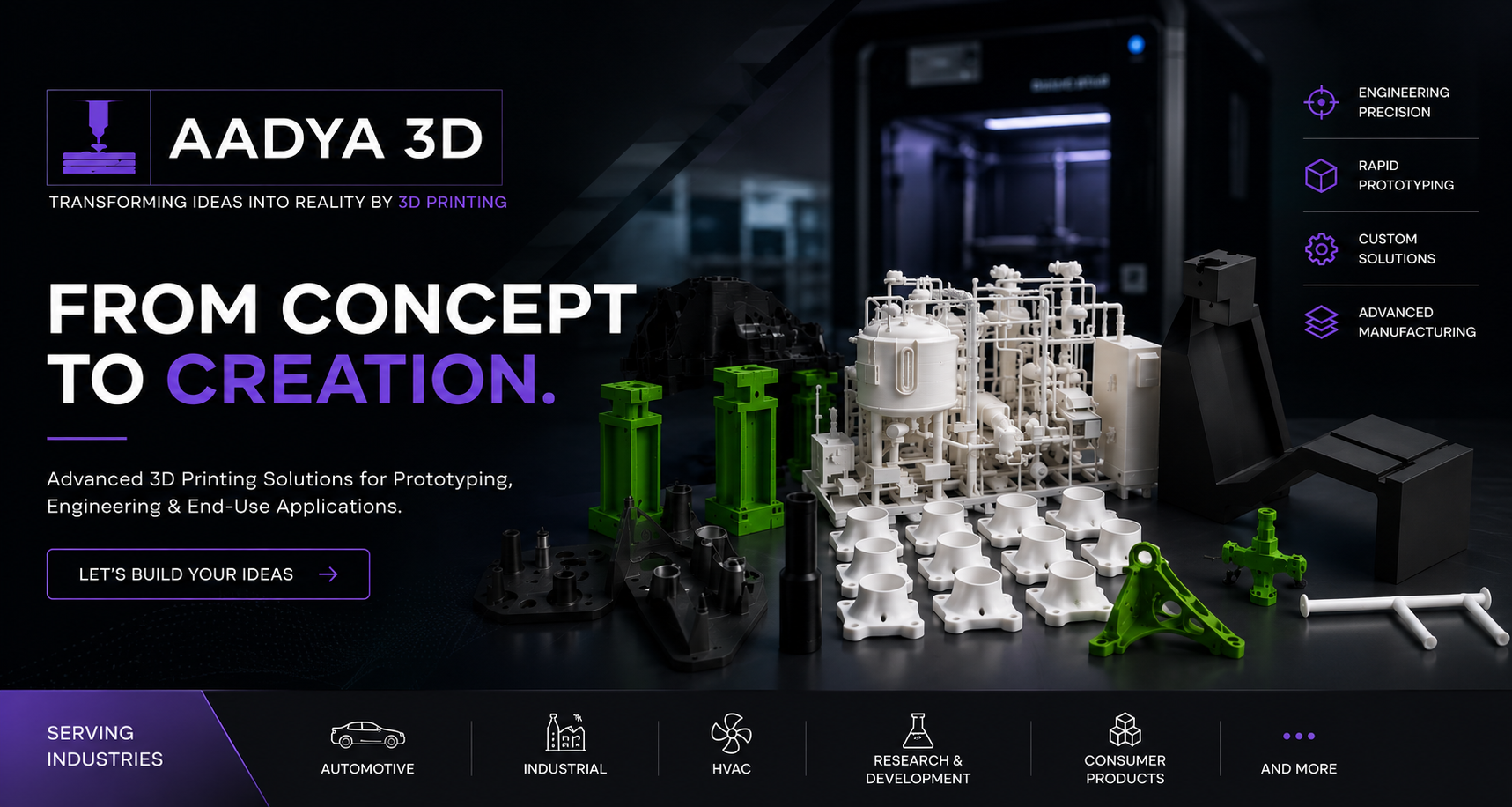
Where do Manufacturing Teams Use Industrial 3D Printing Today?
Every manufacturing team eventually meets the obstacle: a prototype is required before machining can start, a jig takes longer to make than the part it holds, a spare part is no longer supplied by the original vendor, or a small production run does not justify the cost of tooling. These are not situations. They are recurring engineering problems that slow production, raise costs and lengthen development schedules.
Industrial additive manufacturing solves these problems directly. It creates engineering components, from CAD files without special tooling within days instead of weeks. This blog explains where manufacturing teams use 3D printing today what kinds of components are made and how it fits into real manufacturing operations.
Where are Industries Using Industrial 3D Printing?
Industrial additive manufacturing has come a way from just making prototypes. Now it is used in engineering and manufacturing settings to handle specific production problems. It is not meant to take the place of methods. Instead it works as an more adaptable helper, to those methods.
Automotive and Component Manufacturing
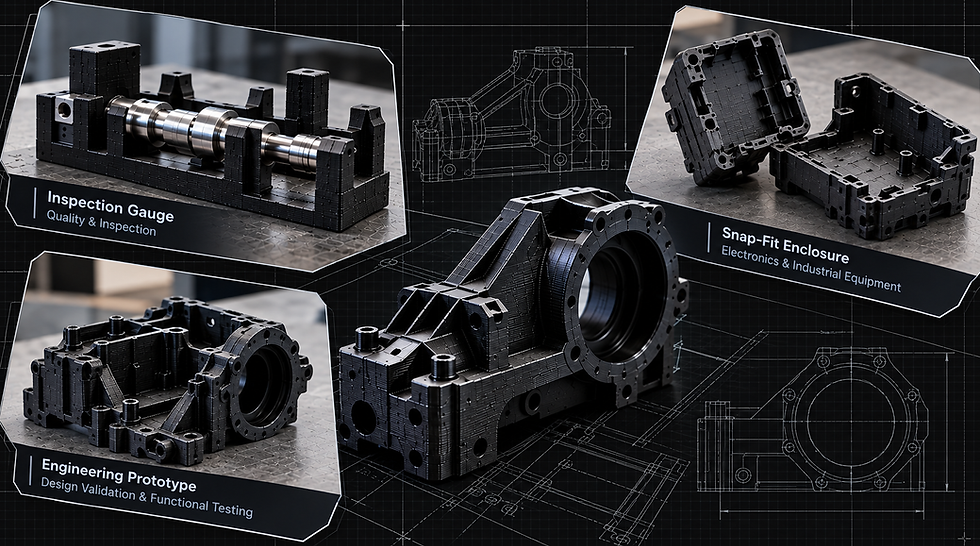
In automotive development and component manufacturing, additive manufacturing is used for design validation, functional prototypes, custom components, manufacturing aids, and production tooling. Engineering teams can now produce parts directly from CAD for fit, form, and functional evaluation before committing to large scale production which involves tooling and molding. The ability to modify designs and produce revised parts quickly makes additive manufacturing useful throughout product development and manufacturing workflows.
Chemical and Process Industries
In chemical and process industries, additive manufacturing can support custom engineering components, fluid-handling components, equipment accessories, functional housings, manufacturing aids, and replacement and/or legacy parts. It is particularly useful where components require specific geometries, modifications, or short lead times. Material selection and component suitability depend on the required mechanical, thermal, chemical, and operating conditions of each application.
Engineering and General Manufacturing
3D printing is used by production teams for manufacturing jigs, fixtures, gauges, manufacturing aids, assembly tooling, replacement components, and other functional production parts. The ability to create and modify these items quickly helps to reduce development time and adapt manufacturing support equipment when process requirements change.
Consumer Product Development
Product development teams use 3D printing to evaluate form, fitment, ergonomics, assembly, and functional requirements before committing to tooling. Rapid prototyping allows multiple design iterations to be produced and evaluated in a shorter development cycle. For limited runs, customized products, and early-stage production, additive manufacturing can also support short-run manufacturing without the initial tooling investment associated with conventional production methods.
Research and Development
Research and development teams use 3D printing for experimental components, test hardware, development models, laboratory fixtures, and proof-of-concept builds. Additive manufacturing allows physical versions of design concepts to be produced quickly, making it easier to evaluate geometry, fit, functionality, and design changes during development.
Engineering Components Manufactured Using 3D Printing
The value of 3D printing for industrial components is best understood through the components it produces rather than the machines themselves.

Jigs and Fixtures
Assembly fixtures, Inspection fixtures, Location fixtures, and positioning tools designed for specific production operations. 3D printed tooling is produced faster and at lower cost than machined equivalents, and redesigned and bought to process immediately when process requirements change.
Gauges
Go/no-go gauges, checking fixtures, in-process gauges and dimensional verification gauges used by manufacturing and quality teams are produced within 1-3 working days from a CAD file — significantly faster than conventional gauge manufacture.
Functional Prototypes
Prototype housings, mechanical assemblies, evaluation models and fitment validation components used during product development before production tooling and molding is committed.
Spare and Replacement Parts
Replacement knobs, covers, adapters, fluid handling components and discontinued plastic parts produced on demand from CAD models or with help of reverse-engineered geometry. Particularly valuable for legacy machinery where original tooling and/or spares no longer exists.
Low-Volume Production Components
Machine brackets, protective covers, custom enclosures and industrial accessories manufactured in small quantities without tooling investment. Low volume production using 3D printing comes into picture here. Suited for production runs where injection molding or machining is not economically viable, which previously had no other option that those but with 3D printing it is possible now without tooling and molding investment.
AADYA 3D — Project Snapshot

A recent project involved manufacturing a custom fluid extraction component for a chemical processing application. The component required a specific geometry for controlled fluid removal from industrial drums. This was a typical example of reverse engineering workflow. The part was designed in CAD from the sample, validated against the application requirement, and delivered as a functional printed component within the standard turnaround. No tooling investment was required.
Frequently Asked Questions
What types of manufacturing components can be produced using industrial 3D printing?
Functional prototypes, jigs and fixtures, inspection gauges, low-volume production parts, spare and replacement components, and custom manufacturing aids are all common applications. The strongest use cases are components where conventional tooling is too expensive, too slow, or not available for the required quantity.
Is industrial 3D printing suitable for shop floor use?
Yes. Engineering-grade thermoplastics offer the rigidity, impact resistance and temperature performance needed for production floor environments. Material selection is confirmed based on the specific application and operating conditions.
Can 3D printing produce components for chemical industry applications?
Yes. Chemically resistant materials are suitable for many non-aggressive fluid and chemical environments. Each application is assessed individually against the chemical exposure, operating pressure and temperature conditions involved.
How quickly can industrial 3D printed components be delivered?
Most components are delivered within 2-5 working days depending on complexity, material and quantity. Inspection gauges and simpler components are typically ready within 1-3 working days. Contact us for lead times on your specific requirement.
Can AADYA 3D manufacture components if I only have a physical sample and no CAD file?
Yes. Where suitable, Aadya-3D can work from a physical sample, measure the component, recreate the CAD model, and manufacture the 3D-printed part. The suitability of the approach depends on the component's geometry, required accuracy, and application.
Working With AADYA 3D
AADYA 3D Engineering Systems provides additive manufacturing services for engineering and manufacturing teams across India. From inspection gauges and production fixtures to custom components and rapid prototypes — we work from your CAD file or physical sample and deliver functional parts within agreed timelines.
Have an Engineering Component to Manufacture?
Share your CAD model, drawing, physical sample, or component requirement with Aadya-3D. We can discuss the appropriate additive manufacturing approach for prototyping, custom components, manufacturing aids, and low-volume production.
Comments